1. Two decks, one joker, 13 cards each
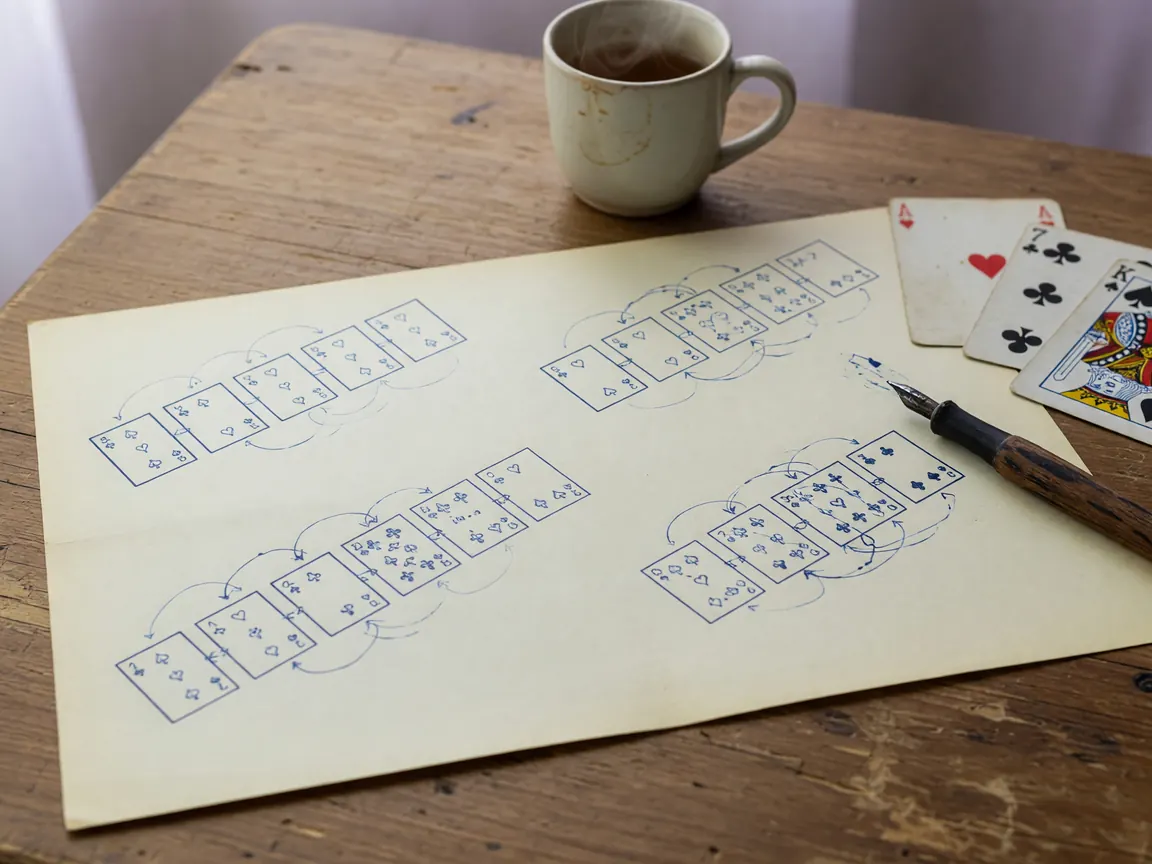
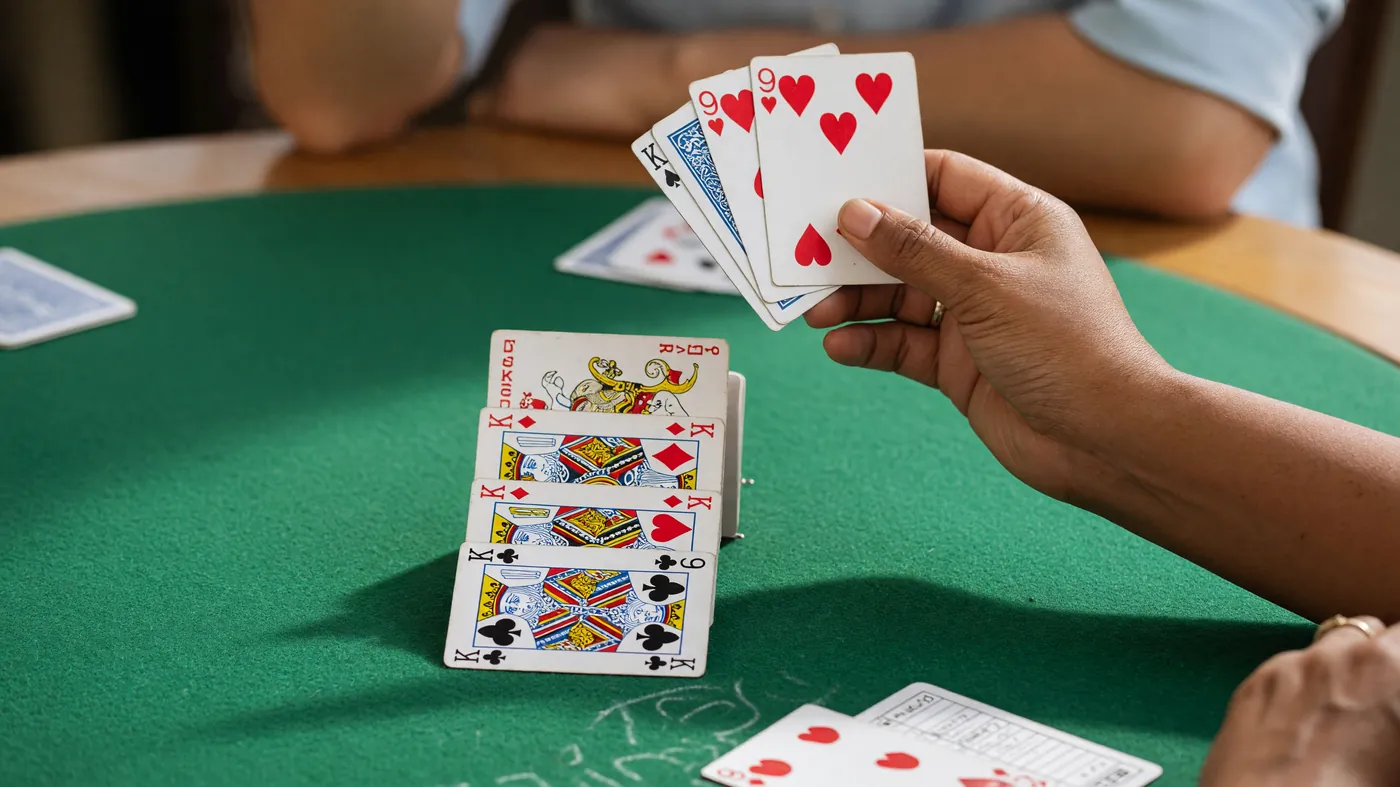
Standard play uses two shuffled 52-card decks plus two printed jokers. One joker is drawn at the start of the round and announced as the wild joker for that round. Cards rank A, 2, 3, 4, 5, 6, 7, 8, 9, 10, J, Q, K, A. Suits are spades, hearts, clubs, diamonds. Each player receives 13 cards face down. The remaining deck becomes the closed pile. One card is turned face up to start the discard pile.
Why two decks: a single 52-card deck only has four of each card, so a six-player table would leave only one card per player in any rank. Two decks restore the variety and make hand reading a richer arithmetic problem.
2. A valid declaration has two sequences and one set
A declaration is the act of laying all 13 cards face up on the table in groups and announcing zero. To be valid, the declared hand must contain at least two sequences and at least one set. One of the two sequences must be a pure sequence. The remaining cards may form additional sequences, additional sets, or remain unmatched at zero points.
3. A pure sequence cannot use a joker
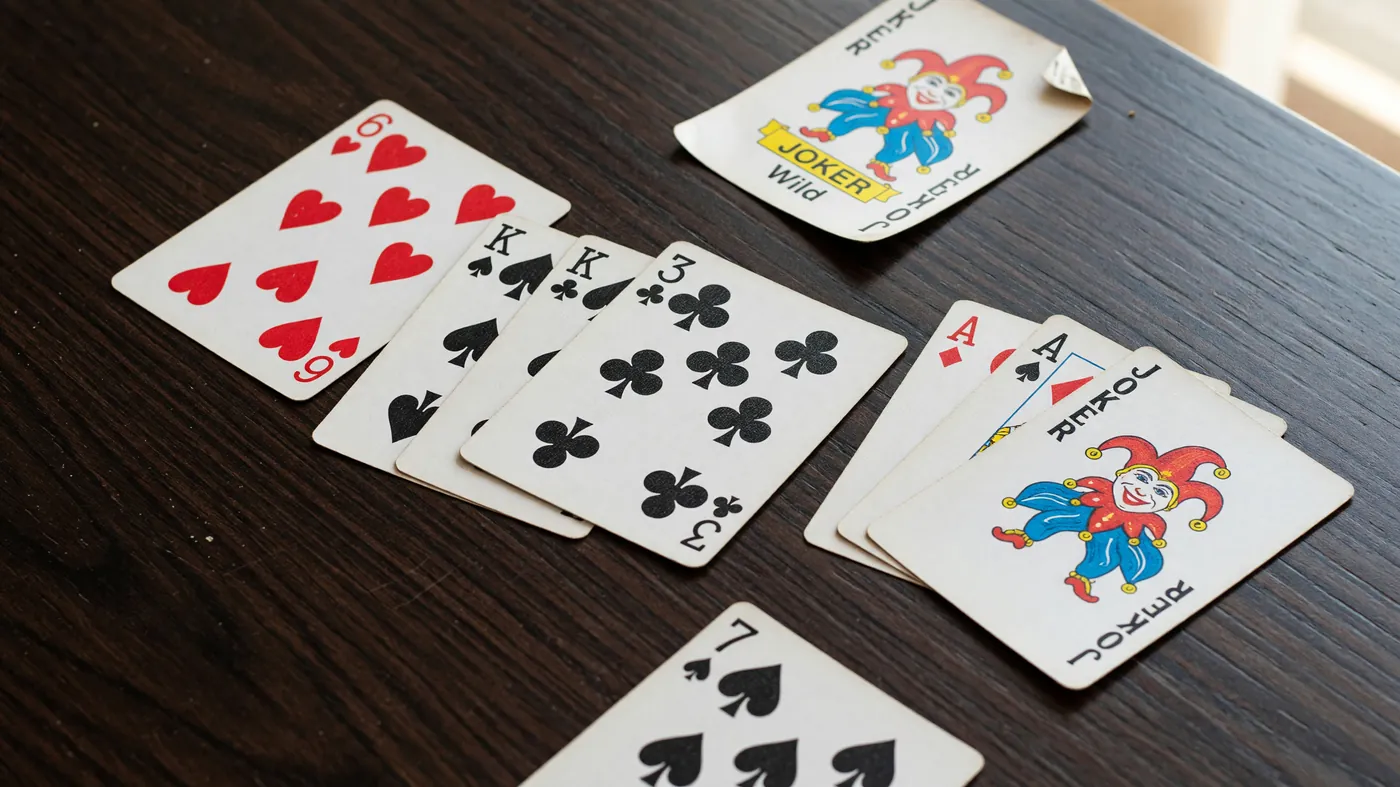
A run containing a joker is called an impure sequence and does not satisfy the pure sequence requirement. The joker may replace any card except inside a pure sequence. A pure sequence is the format's anchor: it confirms that the player has at least one clean suit run and prevents wild-card-only declarations.
4. A set is three or four cards of the same rank, different suits
A set is three or four cards of the same rank with each card from a different suit. You cannot have two cards of the same suit and rank in the same set because the deck has only one of each suit and rank. A set of four with a joker is treated as a set of three with one spare card, not as a four-of-a-kind.
"Two sequences, one pure sequence." That single line is the format's signature sentence. Memorise it before any other rule. The other rules describe what a declaration can be. This line describes what it must be.The Parimatch editorial desk
5. Maximum points in a declared hand is zero
The winning player records zero. The losing player adds up the points of their unmatched cards and that total is settled against the winner. A valid declaration scores zero regardless of the original hand. An invalid declaration scores eighty points, which is the maximum penalty the format imposes on a mistaken declaration.
6. Drop mid-round carries a fixed penalty
A first drop (before picking any card) costs 20 points. A middle drop (after picking but before the last draw) costs 40 points. A full miss (failing to declare when it is your turn) costs 80 points. The drop penalties are designed to discourage leaving a round the moment the hand looks bad. A player who drops habitually is the easiest player at the table to read.
7. One card is drawn and one is discarded per turn
The draw is either the top of the closed pile or the top of the discard pile. The discard must be exactly one card, placed face-up on the discard pile. A turn with no draw and no discard is not a valid turn. A turn that draws two cards is not a valid turn. Show time is a separate phase, not a turn.
The joker, in working order
The joker is the most common source of mistakes in beginner play. Treat it as a finished-set tool, not as a save. The discipline is to spend the joker within the first four picks on a clear set of three-of-a-kind. A joker held but unused adds ten points of deadwood if you lose the round, and the longer you hold it the more likely the rest of the table is to read your hand.
Print jokers pulled during the deal are also wild. They can sit in the hand or be discarded. If you discard a print joker, you signal to the table that you do not need a wildcard for the moment. If you hold a print joker, you are showing a small weakness to the table and should plan to use it within three picks.
The point math
Face cards (J, Q, K) and the ten count ten points. Numbered cards count their face value. Aces count one point in most rules and ten in some. Print jokers count zero points. The printed wild joker counts the value of the card it replaces when discarded; if it is held unused at the end of the round it counts as ten points.
The reading order
The desk recommends this reading order for an adult new to the format: rules first, declaration logic second, joker discipline third, point math fourth, drop penalties fifth, discard window sixth, format glossary seventh. Each step assumes the previous one is in your hands. Skipping steps is the most common source of avoidable losses.
The five most common mistakes
- Throwing a card that closes the only pure sequence in the hand. Sort by intent before you sort by suit.
- Holding the printed joker for more than four picks without using it. A joker held is ten points waiting to be charged.
- Drawing from the discard pile without checking whether the previous player still needs the card. A pick from the discard is a tell.
- Declaring a hand you cannot describe in one sentence. If you cannot describe it, you cannot defend it.
- Forgetting the middle drop. A middle drop is 40 points, but a full miss is 80. Drop before the last draw if the hand is bad.